Bluetooth Speaker Specs Explained: Rated Power, Battery, Bluetooth 5.3 and TWS — What Buyers Should Check
Also available in: Español · العربية · 中文 · Русский · Bahasa Indonesia
The short answer
Five numbers decide whether a speaker spec sheet is honest: rated power with its distortion limit, battery capacity and voltage, playtime at a stated volume, the Bluetooth version and codec, and how TWS pairing works. You can cross-check three of them with a calculator before you ever order a sample.
Rated power vs peak power
Rated (RMS) power is what the amplifier can deliver continuously at a stated distortion level. Peak, music or PMPO power is a momentary figure that can be several times larger and is not comparable between suppliers. A spec that says "30 W" is meaningful only if it also says how it was measured.
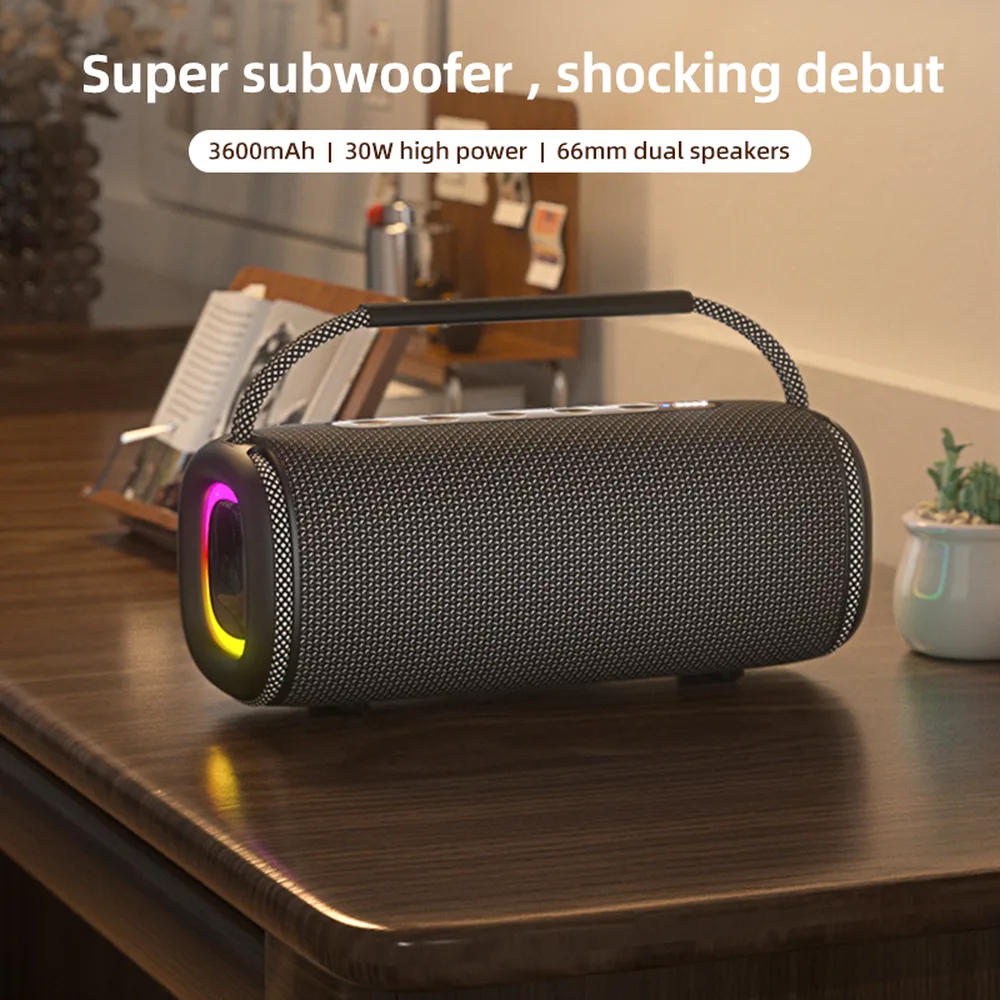
Our EBS-617 lists rated power of 30 W from two 15 W speaker units with dual diaphragms, distortion ≤3% and a signal-to-noise ratio ≥80 dB. Ask every supplier for the same three numbers: rated power, the distortion at which it is measured, and the signal-to-noise ratio.
The battery sanity check
Watt-hours = voltage × capacity in amp-hours. For the EBS-617: 3.7 V × 3.6 Ah ≈ 13.3 Wh. Now compare it with the claimed playtime of 5–6 hours at full volume:
| Check | Calculation | Result |
|---|---|---|
| Battery energy | 3.7 V × 3.6 Ah | ≈ 13.3 Wh |
| Average draw at full volume | 13.3 Wh ÷ 5–6 h | ≈ 2.2–2.7 W |
| Charge time at 5 V 1 A (5 W) | 13.3 Wh ÷ 5 W, plus charging losses | ≈ 3 h (the sheet says about 3 h) |
The first line is the lesson: a "30 W" speaker does not draw 30 W for hours. Music is dynamic and most of the time the amplifier is far below its rated maximum, so real playtime depends on the content and the volume. A claim of 30 W rated power together with 12 hours at full volume from a small battery would not add up. This is an estimate that ignores efficiency losses, but it is enough to catch impossible claims.
Bluetooth version: what actually changes
Speakers stream music over classic Bluetooth, and the sound you hear is set by the codec, the amplifier and the drivers, not by the version number. Newer versions bring improvements to range, stability, power use and newer features such as LE Audio (Bluetooth 5.2 and later), but the real gain depends on the chipset and the antenna design.
| Item | Bluetooth 4.1 (EBS-508) | Bluetooth 5.3 (EBS-617) |
|---|---|---|
| Typical claim | Up to 20 m wireless range | ≥20 m barrier-free |
| What to ask | Pairing stability, reconnect speed | Chipset model, codecs supported |
| Good for | Price-led pocket speakers | Party speakers that stay connected through walls |
- SBC is the baseline codec; AAC or others work only if both the chipset and the phone support them. Ask which codecs are supported.
- Range claims are measured in open air. Expect less indoors; test the sample in a real home.
- To put the Bluetooth name or logo on packaging, the product needs a Bluetooth qualification listing. Ask for the reference.
How TWS pairing works — and where it fails
TWS (True Wireless Stereo) pairs two speakers of the same model. Depending on firmware, the pair plays as left-right stereo or both play the same channel for a louder party effect. Questions to ask:
- Does the pair play real left/right stereo or the same channel on both?
- Is pairing limited to the same model and firmware? Mixed batches are a classic cause of failed pairing.
- Does one speaker lose connection if the other is turned off?
- What happens when a phone call comes in?
The EBS-508 and EBS-617 both support TWS pairing of two units.
Spec checklist to send to every supplier
| Spec | Red flag | Ask for |
|---|---|---|
| Power | "100 W" with no rating basis | Rated W, distortion limit, S/N ratio |
| Battery | mAh with no voltage | mAh + V → Wh |
| Playtime | One number, no volume | Hours at 100% and at 50% volume |
| Bluetooth | Version only | Version, codecs, range test, qualification reference |
| Water resistance | "Waterproof" | IP code and test report — see IPX ratings explained |
| Inputs | Not stated | TF, USB, AUX, charging port type |
Put it in your price calculation
Real specs decide your return rate and review score, and that decides your margin. Combine the checklist above with landed cost and margin and the sourcing steps in our Bluetooth speaker wholesale guide, and send the battery paperwork to your forwarder early (shipping guide).
Frequently asked questions
What does 30 W mean on a Bluetooth speaker?
It should mean continuous (RMS) power at a stated distortion. If a supplier cannot say how it was measured, treat it as a marketing number.
Is Bluetooth 5.3 better than 4.1?
Usually, for stability and power use, but sound quality depends on the codec, amplifier and drivers more than on the version.
How long should a 3600 mAh speaker last?
About 13.3 Wh of energy: several hours at moderate volume. Our EBS-617 lists 5–6 h at full volume and 8 h at 50%.
Can any two speakers be paired with TWS?
Usually only the same model and compatible firmware.
Order an EBS-617 sample, request a quote or browse the full catalog.