AFM/DFM Disablers Explained for Wholesale Buyers: How They Work, Who Buys Them and How to Sell Them Honestly
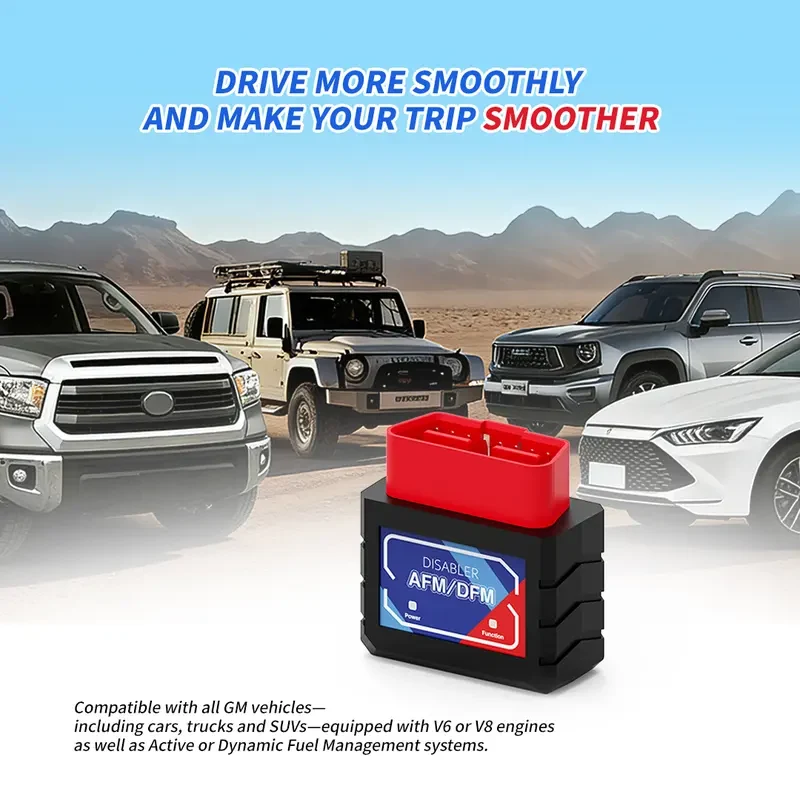
Plug-in AFM/DFM disablers have become a steady niche in automotive accessories, especially among owners of GM trucks and SUVs. They are small, easy to explain on video and simple to ship — but they are also a product where compatibility, honest claims and platform rules decide whether a seller makes money or drowns in returns. This guide explains the category and uses the Sournex AFM/DFM Disabler for GM V6/V8 as the example.
What AFM and DFM actually are
Active Fuel Management (AFM) and its newer evolution Dynamic Fuel Management (DFM) are GM’s names for cylinder deactivation. When the engine does not need full power — steady cruising, light load — the system shuts down some cylinders to use less fuel, then reactivates them when more power is needed. The driver is not supposed to notice, but some owners do: they describe changes in engine sound or vibration when the system switches modes, and some are concerned about long-term wear. That owner sentiment is exactly what creates the market for disablers.
What a plug-in disabler does
According to the product materials, the device plugs into the vehicle’s OBD-II port and is designed to keep the engine running in full-cylinder mode (V6 or V8, all cylinders active) at all times. Installation is three steps — find the OBD-II port, insert the device, wait for the indicator light to come on — and it is reversible by unplugging it, with no tools, disassembly or wiring.
| Question | Straight answer for your listing |
|---|---|
| How is it installed? | Plug into the OBD-II port; no tools or wiring (per the product materials) |
| Can it be undone? | Yes — unplug it to return to normal vehicle behavior |
| What does it change? | Keeps the engine in full-cylinder mode instead of cylinder-deactivation mode |
| What is it not? | It is not a tuning chip or a power upgrade; do not promise horsepower gains |
Who buys this product
- Owners of GM V8 trucks and SUVs who dislike the mode transitions.
- Independent garages and installers who want a quick, no-teardown upsell.
- Online sellers on marketplaces and short-video shops serving the GM owner community.
- Accessory distributors who already carry OBD-II tools and want a focused, fast-moving SKU.
Compatibility is everything
The Sournex disabler is designed for GM vehicles with V6 or V8 engines and AFM/DFM systems, and the compatibility chart covers a broad range of Chevrolet, GMC, Cadillac, Buick and other GM-group models over roughly 2004–2022 — for example GMC Sierra 1500, Chevrolet Silverado 1500, Suburban, Tahoe, GMC Yukon, Camaro, Cadillac Escalade, Colorado and Canyon.
A single wrong-fitment order costs a sale, a return shipment and often a bad review. Reduce the risk:
- Publish the full compatibility chart on your product page, not just “fits GM.”
- Ask buyers for model year and engine size, or add a simple year / model / engine selector.
- Put the engine size (for example 5.3L, 6.0L, 6.2L) next to every listed model.
- Make your return policy explicit for “wrong vehicle” cases.
What to claim — and what to avoid
| Safe to say | Avoid unless you can prove it |
|---|---|
| “Plug-and-play OBD-II device; no tools or wiring” | “Guaranteed fuel savings” — keeping all cylinders active generally means the fuel-saving feature of AFM/DFM is not used |
| “Keeps the engine in full-cylinder mode” | “Will not void your warranty” — warranty treatment depends on the manufacturer and the case |
| “Reversible — unplug to restore normal behavior” | “Legal everywhere” — rules differ by country, state and inspection regime |
| “Compatible with the models in our chart” | “Increases horsepower” — it is not a power tuner |
Some marketplaces, ad platforms and payment providers also have policies on engine-control or emissions-related accessories. Read the current rules for each channel before you list, and keep your descriptions factual.
What to ask your supplier
- The full compatibility list by model, engine and year — and whether it was tested on real vehicles.
- How the device behaves when the engine is off (battery drain), and how it behaves on cold start and in hot weather.
- Operating voltage and temperature range, dimensions, weight and packaging size.
- Electronic certifications for your market (such as FCC, CE, RoHS as applicable).
- The OEM / private-label options: housing, label, packaging, insert card and user manual.
A simple test plan for your samples
- Install on at least two different vehicles from the compatibility chart.
- Confirm the indicator light behavior and that no warning lights appear after installation.
- Check idle, city driving and steady highway cruising; note any change in engine behavior.
- Leave the vehicle parked for a couple of days and check the battery.
- Remove the device and confirm the vehicle returns to normal.
- Film the three-step installation — that video is your best sales asset.
Before you commit volume, read why sample orders matter, check the economics with the landed-cost and margin guide, and plan an inspection with the pre-shipment inspection guide. For first-time importers, common mistakes to avoid is a good checklist, and the shipping guide explains how small electronic parcels travel.
Frequently asked questions
Is it really plug and play?
According to the product materials, yes: insert it into the OBD-II port and wait for the indicator light. No tools, disassembly or wiring are needed.
Can the buyer remove it?
Yes. The device is reversible — unplugging it returns the vehicle to its normal behavior.
Which vehicles does it fit?
GM vehicles with V6 or V8 engines and AFM / DFM systems, across a broad range of models from roughly 2004 to 2022. Check the compatibility chart and confirm model year and engine before ordering.
Does it improve fuel economy or power?
No promises on either. It keeps the engine in full-cylinder mode; it is not a tuner, and fuel consumption can differ from the same vehicle in cylinder-deactivation mode.
What is the MOQ and can I add my own branding?
MOQ is 10 pieces with tiered FOB Shenzhen pricing. OEM and private-label options are available on request.
Ready to evaluate it? View the AFM/DFM Disabler for GM V6/V8 or send an inquiry — see how to write an inquiry for what to include.