Portable Mini Projectors for Resellers: What 720p and 100 ANSI Lumens Really Mean — and Who Should Buy
Portable mini projectors have become an easy add-on for gift shops, online sellers and electronics retailers: they are compact, photogenic and priced for impulse buying. They are also one of the most return-prone categories when a buyer expects a “home theater” and receives an entry-level device. The fix is not a different product — it is honest positioning. This guide uses the Sournex Portable Android 14 Projector with 360° Gimbal Stand to show how to do that.
What this projector is — and is not
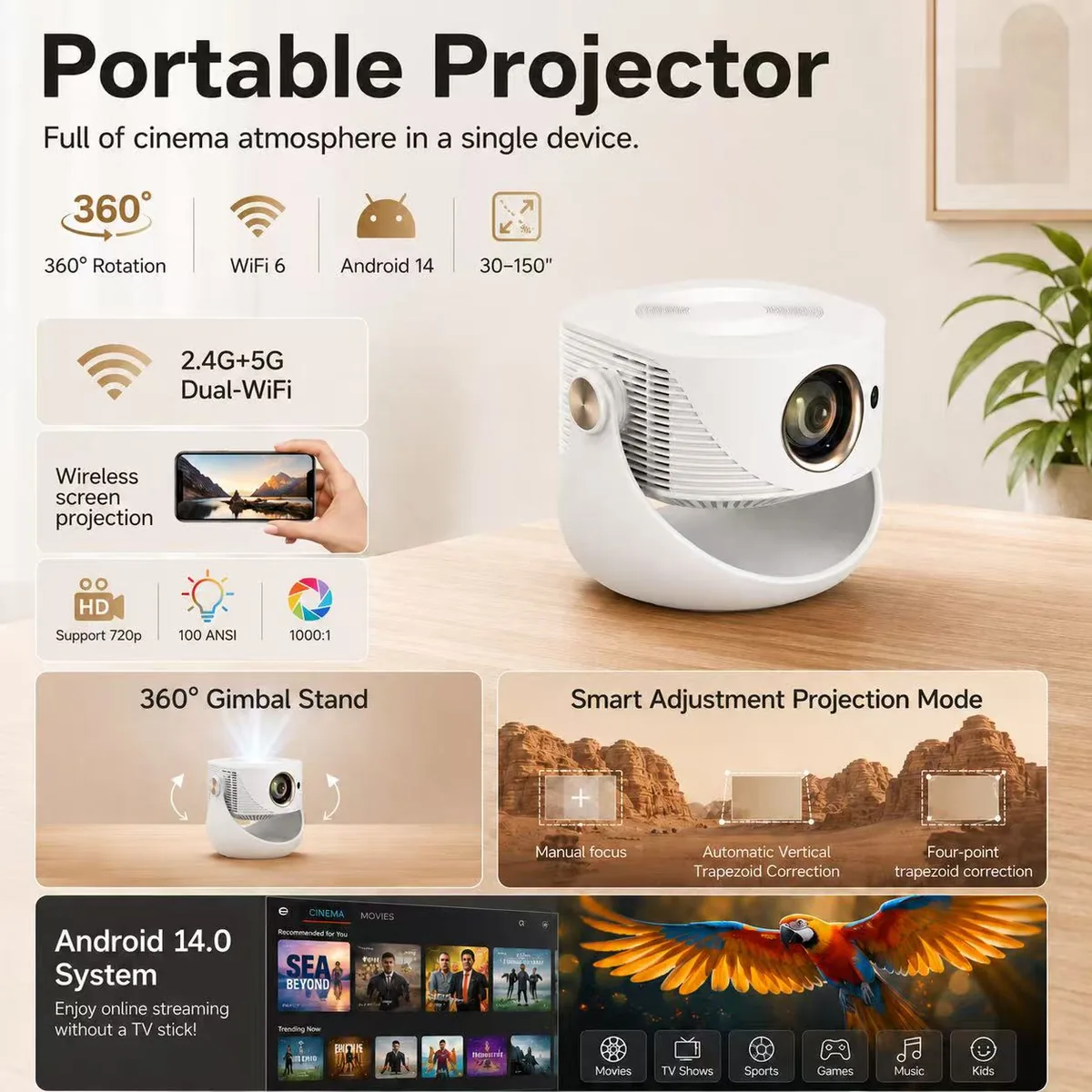
The marketed specification is: Android 14 system, dual-band WiFi 6 (2.4G + 5G), Bluetooth, support for 720p HD playback, 100 ANSI lumens brightness, 1000:1 contrast ratio, a 30–150 inch projection size and a 360° gimbal stand, with manual focus, automatic vertical correction and four-point trapezoid correction.
Read plainly, that is a compact entry-level portable projector. It is designed for dark or dim rooms, smaller image sizes, casual viewing and mobility — not for bright living rooms or large-group presentations. Sold on those terms it satisfies customers; sold as a replacement for a large-screen TV it will not.
Decoding 720p and 100 ANSI lumens
| Spec | What it means in daily use | How to describe it honestly |
|---|---|---|
| 720p (HD) | Good for videos, cartoons and casual movies at modest screen sizes; fine text will look softer than on Full HD | “HD 720p playback” — not “Full HD” or “4K” |
| 100 ANSI lumens | Best in a darkened room; daylight washes the picture out quickly | “Best in dark or dim rooms; ideal for bedrooms, kids’ rooms and evening outdoor use” |
| 1000:1 contrast | Adequate for a basic projector; dark scenes look best in a dark room | Mention only alongside lighting advice |
| 30–150 inch | The range the optics can project; picture quality is best at the smaller end of the range | “Up to 150 inches” along with the recommended 40–100 inch range for best results (confirm on your sample) |
The 30–150 inch figure describes how large the picture can be made, not how large it will look good. With low brightness, the bigger you project the dimmer the image gets. Give your customers a recommended size range based on what you see on your sample — it will cut returns more than any other single sentence in the listing.
Who this projector is a good fit for
- Kids’ rooms and bedrooms — projecting cartoons or movies on a wall at night, with a gimbal stand that makes angling easy.
- Camping and backyard evenings — a small, light device and a plain white wall, sheet or portable screen after sunset.
- Gift buyers — a self-contained Android device that works without a TV stick.
- Secondary-room use — a second screen for a study, dorm or guest room.
It is a weaker fit for daytime living-room viewing, business presentations in lit rooms, or buyers who specifically want “4K” or “Full HD.” If that is your customer, look at our native 1080P smart projector instead.
Why the 360° gimbal stand matters
The gimbal stand lets the body rotate and tilt around the stand, so a customer can aim the picture at a wall or ceiling without stacking books underneath. For a bedroom projector that is a genuine usability win and it photographs well for listings. On a sample, check that the stand holds firmly at steep angles, that the lens is not blocked by the base at extreme tilt, and that rotation is smooth without clicking or drift.
Wireless mirroring, WiFi 6 and Bluetooth
- Dual-band WiFi 6 (2.4G + 5G) supports streaming apps and phone / tablet / laptop wireless projection.
- Bluetooth lets customers send sound to headphones or a speaker — useful because small projectors have modest built-in audio. The product materials show both BT 5.0 and BT 5.3 in different images, so ask the factory to confirm the version on your configuration.
- Screen mirroring behavior differs between iPhone and Android and between apps. Test the exact mirroring method on both phone types and record a short how-to to include in your listing or insert card.
Android 14 and apps
Android 14 with an app store means customers can install streaming and entertainment apps directly. As with any smart projector, do not claim specific streaming services as “built in” unless you have confirmed their availability and licensing for your market on a real sample.
Sample-testing checklist
- Project in a dark room and in a room with some light; photograph both for your listing.
- Measure the largest size where the picture still looks acceptable.
- Test manual focus, automatic vertical correction and four-point correction.
- Mirror an iPhone and an Android phone over WiFi; check lag and audio sync.
- Pair Bluetooth headphones and a Bluetooth speaker.
- Run it continuously for a few hours; check fan noise and surface temperature.
- Confirm power input, plug type, remote and certification documents for your market.
Before you place a volume order, read why sample orders matter, and plan your inventory around demand peaks with planning orders around peak season. A pre-shipment check on your first order is covered in the inspection guide.
Frequently asked questions
Is it Full HD or 4K?
No. The marketed specification is support for 720p HD playback. It is positioned as an entry-level portable projector.
How bright is it?
The marketed brightness is 100 ANSI lumens, so it is best in dark or dim rooms. Ask for the factory datasheet and test your sample under your typical lighting.
Can it mirror an iPhone?
The product supports wireless screen projection over dual-band WiFi 6. Behavior varies by phone and method, so verify on your own devices before advertising it.
Can it be used outdoors?
Yes, in the evening or at night with a plain wall, sheet or portable screen. Daylight will wash out a 100 ANSI lumens image.
What is the MOQ and can I customize it?
MOQ is 10 pieces with tiered FOB Shenzhen pricing. OEM and private-label options are available on request.
Ready to add it to your range? See the Portable Android 14 Projector or send an inquiry for pricing and a sample.